We reject the cloud-by-default assumption.
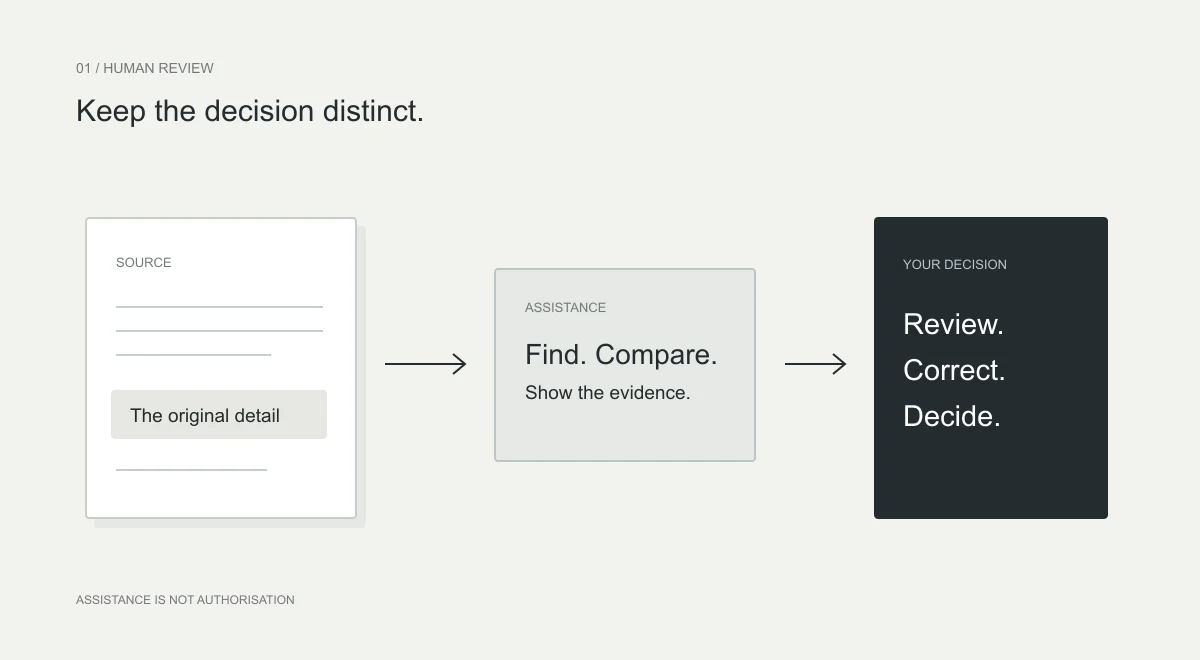
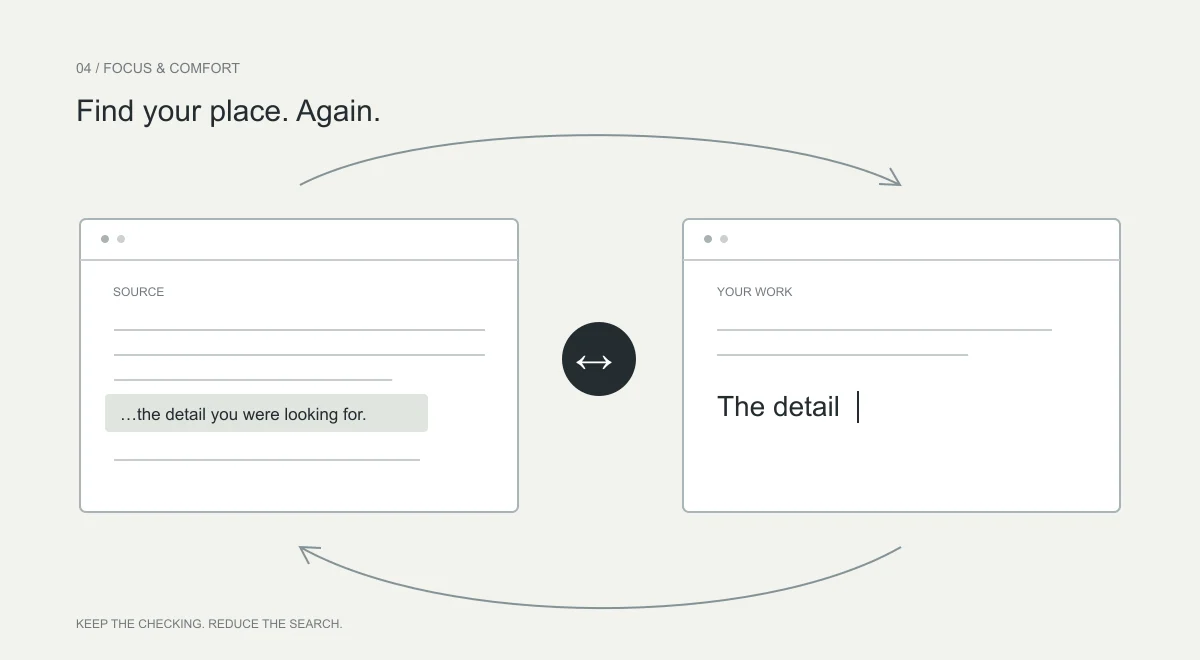
An invoice already contains the amount. A research paper already contains the passage. Helping you keep that information beside your work does not, in our view, justify sending the document to a remote generative model.
We do not think every useful feature needs a cloud AI service attached to it. Nor should people have to accept secondary uses of their information simply to make an ordinary task less frustrating. Convenience should not quietly become permission.
That is Relayne’s position on document assistance. It is deliberately narrower, and more concrete, than claiming “all AI is bad.” AI is an umbrella term. Local text recognition and a remotely hosted generative model do not have the same data flow. The question is what information leaves, for what purpose and under whose control.
Your work should be the purpose of the tool. Not the raw material for another business.
Data reuse is not an imaginary concern.
There are documented cases where the purpose people understood did not match how their information was handled. In 2021, the US Federal Trade Commission finalised a settlement with Everalbum over alleged deception involving facial recognition and retention of users’ photos. The settlement included deletion of models and algorithms developed using users’ uploaded photos and videos. This was a specific enforcement case, not a finding about every photo service or every AI model. US Federal Trade Commission, 2021.
In a separate 2023 complaint, the FTC and DOJ alleged that Amazon retained children’s Alexa recordings and failed to honour deletion promises, using unlawfully retained data to improve its algorithm. The FTC’s announcement described a proposed court order and a $25 million penalty. Those allegations illustrate the conflict that can arise when service data is also valuable training material; they do not prove that all cloud providers secretly train on documents. US Federal Trade Commission, 2023.
We do not need to turn those cases into a blanket accusation to take them seriously. “It improves the product” is not, by itself, an answer to whether that use was expected, permitted or necessary.
Processing is not the same as training.
A service may process a file to answer your request without using it to train a model. It may still retain the conversation, keep operational logs or involve other processors. A promise about training answers one question, not all of them.
For example, Microsoft’s documentation states that Microsoft 365 Copilot prompts, responses and Microsoft Graph data are not used to train foundation models. That product-specific commitment matters. It is also not the same thing as processing entirely on your computer, and it should not be generalised to every product carrying the Copilot name. Microsoft Learn.
The European Data Protection Board’s 2024 opinion says that whether an AI model is anonymous requires a case-by-case assessment. It also considers legal bases and the implications of unlawfully processed training data. “The model learned from it” is not a shortcut around data-protection questions. European Data Protection Board, 2024.
Where is it processed?
Your device, a provider’s servers, or both?
What is retained?
The document, extracts, conversations or diagnostic records?
What else is it used for?
Only your request, or evaluation, training and other purposes?
Who can change that?
Which settings, contract and service version govern the answer?
The cloud is physical infrastructure.
Remote processing runs on hardware, not a weightless abstraction. In its 2025 Energy and AI report, the International Energy Agency estimated that data centres used 415 TWh of electricity in 2024, around 1.5% of global consumption. That figure covers data centres overall, not AI alone. International Energy Agency, 2025.
This is a reason to ask whether remote computation is necessary, not permission to invent an environmental saving for Relayne. Your computer uses electricity too. Comparing the footprint of two workflows would require actual measurements, the hardware involved and the energy supply.
Our design preference is restraint: do not introduce a remote document-processing dependency where the useful work can happen locally. We can make that choice without claiming that one desktop app solves the environmental impact of computing.
What local means in Relayne.
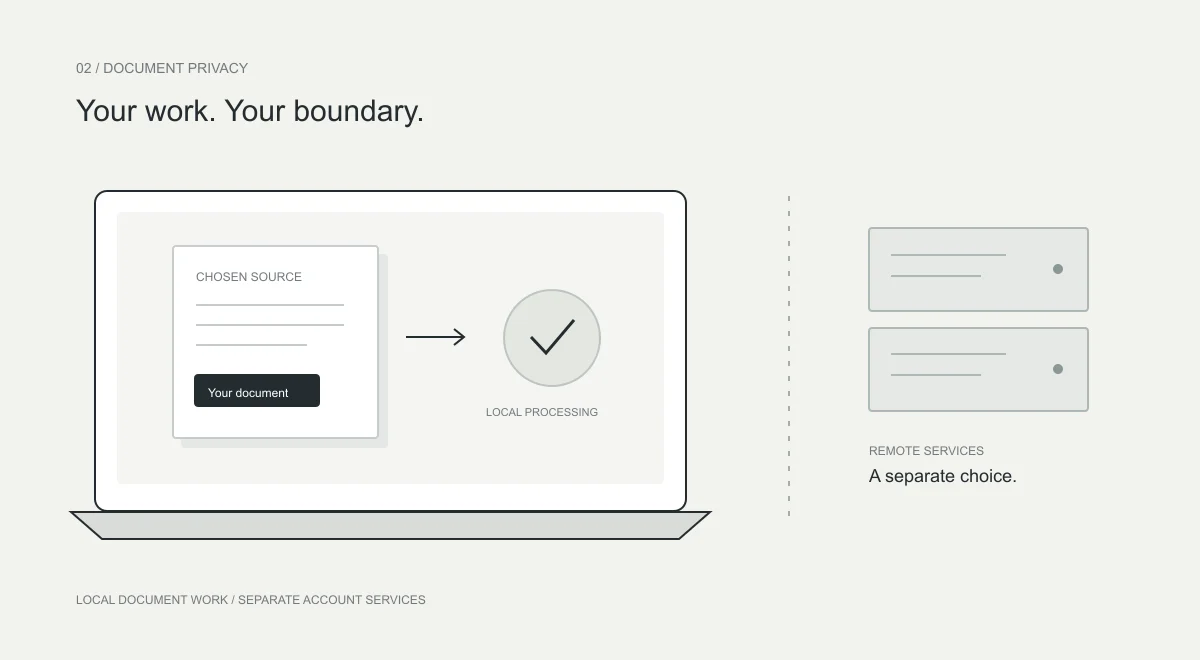
Relayne’s document-assistance flow processes chosen source content on your computer rather than sending it to cloud AI. Bringing an original value or passage beside your work does not require turning that content into a cloud prompt.
The content stays in the local assistance flow.
Account access uses the internet. Local processing does not mean the whole product is network-free.
The destination app remains a separate boundary. If you type into a cloud document or submit a web form, that service handles what you enter under its own rules. Local processing does not change your employer’s policies, secure an infected computer or make any workflow automatically compliant with privacy law.
Support attachments deserve care too. Screenshots and diagnostic files can contain private information. Earlier Relayne Windows beta recordings could retain content locally; older files may remain after an update. Our privacy explanation describes that history and the distinction between documents, account data and support information.
Ask before uploading.
Before sending a work document to any service, identify the exact product and account tier. Read the terms for that service, not a broad promise on a marketing page. Check retention, model-training use, human access, deletion and your organisation’s permission to upload the material.
If you cannot establish those facts, do not treat a smooth interface as an answer. Try a non-confidential example, ask the provider or use an approved local route.
We want software to earn access to information by needing it for the task. Not by collecting everything first and finding a use later.
Sources & further reading.
Research and guidance inform this article. They do not establish Relayne’s effectiveness. Product descriptions follow the current demonstrations and privacy explanation.
- Finalized settlement with Everalbum over facial-recognition practicesUS Federal Trade Commission, 2021
- FTC and DOJ allegations concerning retention of children’s Alexa recordingsUS Federal Trade Commission, 2023
- Opinion on AI models and data-protection principlesEuropean Data Protection Board, 2024
- Data, privacy and security for Microsoft 365 CopilotMicrosoft Learn
- Energy and AI: executive summaryInternational Energy Agency, 2025
Research checked 8 October 2026. Have a correction? Tell the Relayne team.