Not every step is the same decision.
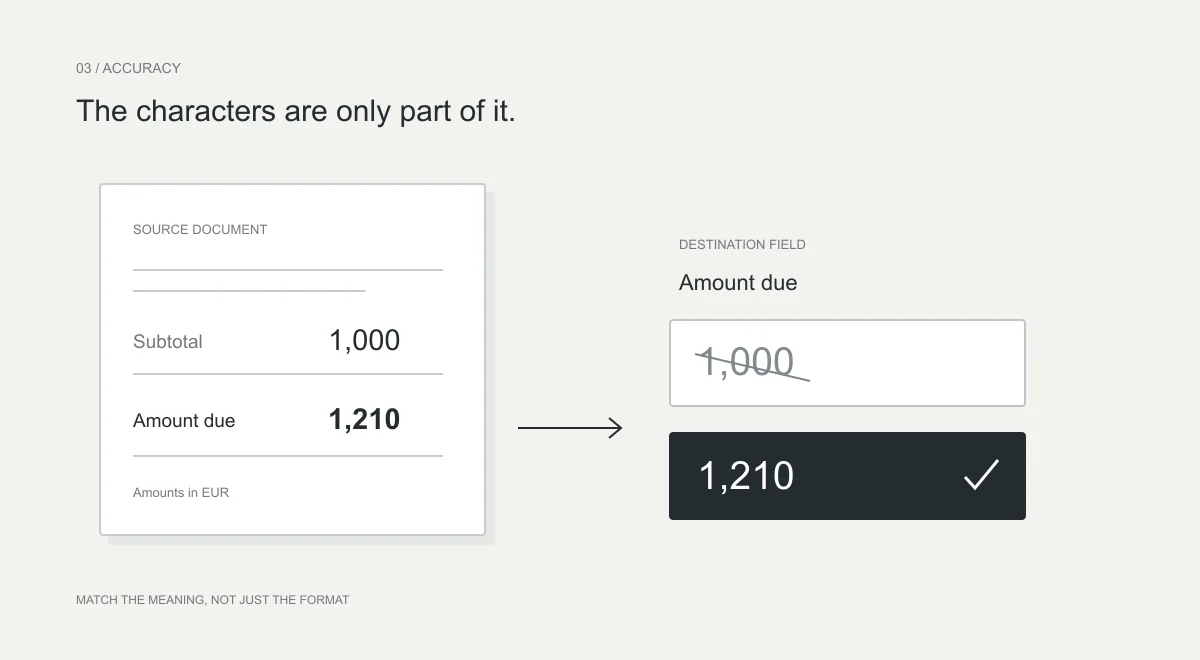
A form can be filled in perfectly and still be wrong. The supplier may be a different company with a similar name. The date may be a delivery date rather than an invoice date. A passage may be copied word for word while losing the qualification that came before it.
These are not all typing problems. Some are recognition problems; others are decisions about meaning, context or permission. Treating them as one task called “data entry” makes it easy to automate more authority than we intended.
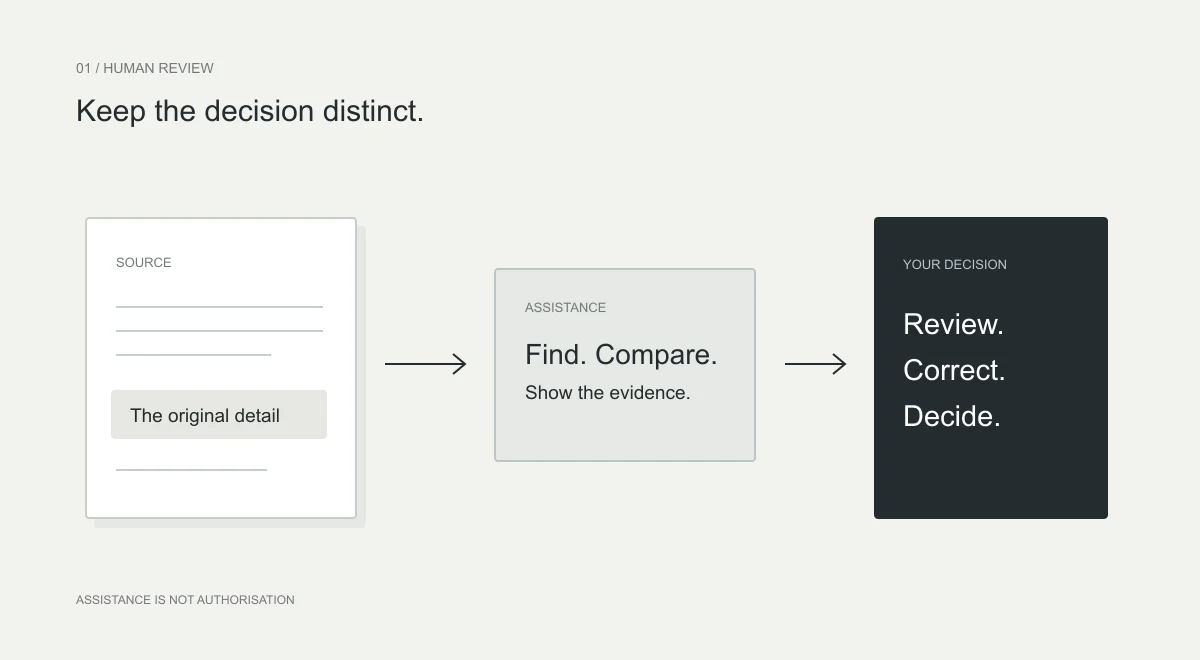
Consider an invoice workflow. Reading the characters, identifying the amount due, putting it in a field and authorising payment are four different acts. Software can assist with one without being authorised to perform all four. That distinction is useful in research, administration and report writing too.
Our view is simple: the more consequential the action, the clearer its evidence and responsibility should be. A polished result is not evidence that every decision behind it was sound.
Good automation earns its place.
A reliable import from a structured export may be better than retyping hundreds of records. A tested formula may be better than repeatedly calculating by hand. If a process has clear inputs, stable rules and a practical way to detect or reverse errors, automation can be an excellent choice.
Manual work is not inherently more accurate. People skip rows, transpose digits and miss details. Keeping a person involved only helps when that person can understand the task and check the result. We should remove unnecessary effort, not preserve it to make a product seem necessary.
Known rules. Checkable output.
A structured import with explicit field mapping, duplicate checks and a reviewable result.
Ambiguous meaning. Lasting consequences.
A document with conflicting parties or unclear amounts, followed by an irreversible submission.
These are decision criteria, not a claim that one category of software is always safe or unsafe. A small, well-tested integration may be more dependable than a large system marketed as intelligent.
A person clicking Approve is not enough.
Adding an approval button does not automatically create meaningful oversight. If the original is hidden, the explanation is missing and the user is under pressure to finish, review can become a ritual.
A systematic review by Goddard and colleagues describes automation bias: people can rely too heavily on automated advice and overlook errors it introduces. The review focuses on healthcare and draws on several research fields. It does not establish an error rate for everyday form filling or for Relayne. It does give us a reason to make verification a real activity rather than an assumed safeguard. Goddard, Roudsari & Wyatt, 2012.
Useful review needs three things: access to the original evidence, a clear view of what will change, and the ability to correct or refuse the action. W3C’s accessibility guidance for certain consequential submissions similarly addresses reversal, checking or confirmation. That is a design principle worth considering, not a compliance claim about this article or the app. W3C Web Accessibility Initiative.
Human review is only meaningful when the human has something meaningful to review.
Four questions before handing over a task.
- Can you define a correct result?
“Put this customer ID in this field” is more precise than “understand this document.” Write down what a valid result must preserve.
- Can you see where it came from?
A value should lead back to the relevant source and context. A confidence score alone does not explain which party, date or row was selected.
- What happens when the input changes?
Try a missing value, a repeated amount, an unfamiliar layout and conflicting information. A system that stops clearly can be more useful than one that guesses silently.
- Can you undo the consequence?
Correcting an unsent draft is different from recovering a completed payment or a message already sent. Put the review before the consequence where possible.
Where Relayne takes a different approach.
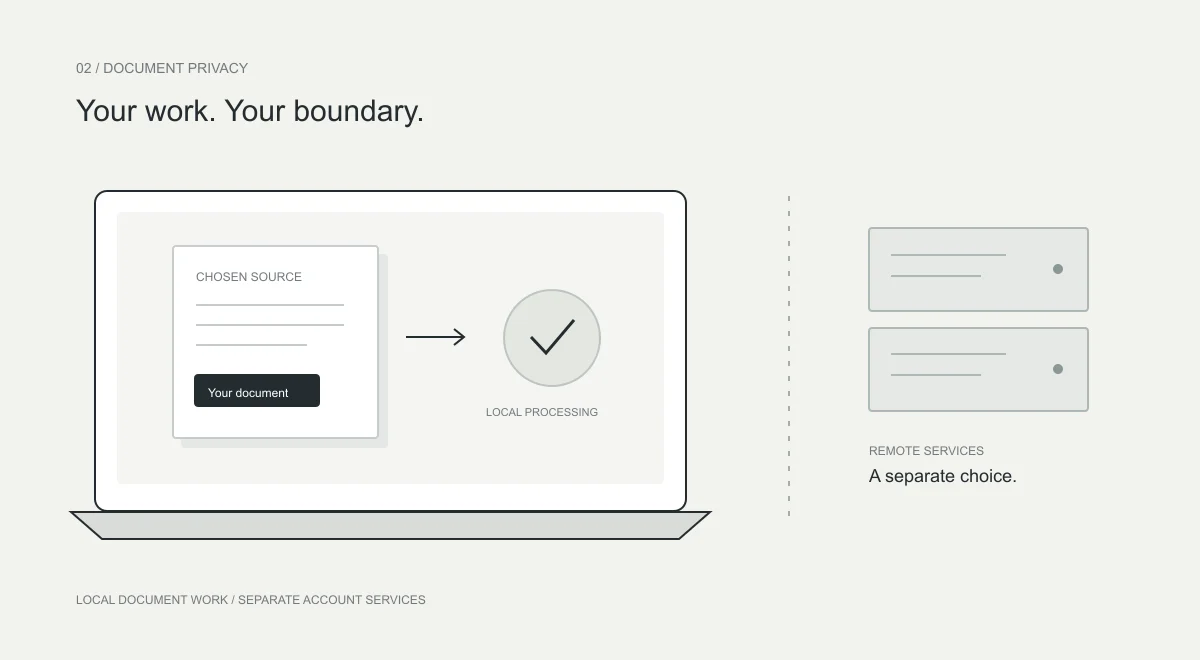
Relayne is being built for the work you still choose to do yourself. Form Assist can bring a matching source value beside a supported field. Text Follow can keep original words beside your writing. Neither feature is permission to invent a missing answer or approve a document.
You remain responsible for deciding what belongs in the destination and for submitting it. A character match is not proof that an invoice is genuine, that a payment is authorised or that a quotation supports your argument.
That is assistance with a deliberate boundary. It is not a rejection of useful automation elsewhere in your workflow. Start with the actual task, decide where judgment belongs, then choose the tool.
Sources & further reading.
Research and guidance inform this article. They do not establish Relayne’s effectiveness. Product descriptions follow the current demonstrations and privacy explanation.
- Automation bias: a systematic review of frequency, effect mediators, and mitigatorsGoddard, Roudsari & Wyatt, 2012
- Understanding error prevention for legal, financial and data submissionsW3C Web Accessibility Initiative
Research checked 8 October 2026. Have a correction? Tell the Relayne team.